
The Baggage of Hope

Reflections of a Newly-Ordained Elder on the Future of United Methodism
Clergy in the United Methodist Church undergo an annual interview with the district superintendent, who is, for those of you who aren’t United Methodists, an overseer of a particular geographical area within the bounds of the conference they serve. Several years ago during this interview with my then-DS I said that I was feeling as though it was time for me to move on in my ministry and be moved to another appointment.
As long as I have breath in my body, I shall never forget his initial response.
Leaning back and looking me squarely in the eye, he said, “you know, there are certain churches…that you simply cannot be appointed to” because at the time I was married to a Black woman.
I was stunned.
“This is the church of Jesus Christ?” were the only words of which I could think at that moment. I went away from that meeting discouraged and somewhat disillusioned.
I lead with that story because on numerous occasions throughout the course of my time with the UMC that same question – “this is the church of Jesus Christ?” – has resurfaced.
When learning of the entrenched racism in American Methodism, it pops up. I cannot help but ask it when a slaveholder is elected to the episcopacy, dividing the Methodist Episcopal Church in 1844 over slavery – which is a departure from our very roots as followers of Christ in the Wesleyan tradition.
I cannot help but ask it knowing the mandate for racial segregation in the Book of Discipline at the creation of the reunified Methodist Church, or that by church law all Black conferences were not to be in any geographic relationship with the church’s white majority out of fear of a Black pastor or Black bishop having oversight over white churches.
I cannot help but ask it when it is made abundantly clear that Methodists “model for the nation a Jim Crow church.”[1]
This is the church of Jesus Christ? Do I have a place here?
I ask those questions when I contemplate the immense seventy six-year struggle my sisters in the faith had to endure just to secure the right to be ordained.[2] They resurface when I remember that Methodism existed in this country for nearly two centuries before women’s ordination finally became a reality. I ask them when I learn that during the women’s ordination debate at the 1956 General Conference that the prevailing attitude among some of its most staunch opponents was, “if we vote for this, we’re opening the door to a woman bishop. Would you want such a thing?”
Is the United Methodist Church, weighted down by such baggage, my home? Is this the church of Jesus Christ?
Those questions were raised as I watched in horror the occurrences at Special General Conference 2019. I shall never forget the feelings of rage, disgust, and utter sadness as I watched the events of the final day unfold along with my co-learners and colleagues at Methodist Theological School of Ohio. The gnawing in the pit of my stomach was unrelenting as the rhetoric of the plenary session became more and more inflammatory – more and more hate-filled.
The first General Rule was being shattered in front of the world, as it was previously in 1969 with the shutdown of Motive, in 1972 with the addition of the restrictive language to the UMC Discipline, and with our gay siblings being depicted as “sexual predators,” “pagans,” and worse.[3]
Is this the church of Jesus Christ, where all are included? Where none are excluded? Where every person is a human being bearing the Divine Image? Is this the place I choose to live and serve? These are the massive issues with which I wrestle as I attempt to answer those questions for myself. The issues are deeply personal, in that they have affected me in my own ministry and relationally, in that they have touched the lives of so many of my colleagues and friends that I hold dear to my heart.
There are times when I sit back and reflect on all the above and wonder how the United Methodist Church can possibly call itself the church of Jesus Christ. There are times when I deeply question whether it is my home.
But then I am reminded of Peter’s words to Christ in the Gospel, “Lord, where else” would I go?
Despite all its stains, I still have hope for this church that I love so very deeply – this church that loved me into God’s reign.
Methodism at its best is a lived faith, offering God’s grace to the widest possible spectrum of people. And even if the highest profile connection that carries the name Methodist currently does not, I still hold out hope that it can and will.
I want to be part of a church that historically empowers society’s most marginalized, offers relief to those who are suffering – a diverse church that offers liberation to the oppressed and salvation in its most complete meaning; the shalom of God.
The United Methodist Church, if we truly claim to be Wesleyan, is supposed to be the church where all have a place and voice at the table. I think that still is possible. I have hope that it can happen, by and through the power of God’s good news.
We are a people that from the beginning have been about moving toward perfection – being on the move, just as God is, toward the least, the last, the lost, and the lonely among us, championing the notion that in Christ there is equality among all people God has created.
We bear hope-carrying stories of a hope-carrying people tasked with giving a hope-filled glimpse of God’s not yet-fulfilled reign in the present. Our church “in its best moments has looked at society and mobilized for change.”[4]
In our best moments we are a church that cares, that does, and can.
A Church That Cares
Methodism in America has a long history of prophetic social activism, standing up and speaking against structural and systemic sin that does incalculable harm to those on the margins. We have taken pride in proclaiming and modeling the “whole” gospel, a holistic good news that focuses on the health and well-being of every aspect of an individual’s life, not a reductionist version of Christianity that only focuses on salvation of the soul and pie in the sky hereafter. With our original antislavery stance at the formation of the Methodist Episcopal Church, the adoption of our Social Creed and later the Social Principles and subsequent resolutions expanding on them, Methodists historically have shown their heart for a broken society and the most broken people within it. Our calling card has always been that we are a people of grace – a people that love our neighbors into a transformative experience of God.
Individuals such as Frank Mason North stand out in this respect. A social gospel pioneer, he used the power of media to educate and enlighten nineteenth century American Methodists on the social ills of the day and how the church is called to address them. In this respect, he also is to be held up as an example of the prophetic voice that by and large the UMC has lost. North stated that the “problem of poverty lies very close to the problem of sin,”[5] and over a century later that still rings true, along with a multitude of other structural sins. That is all the more reason why we still should be seeking to “apply the sane and fervent spirit of Methodism to the social needs of the time.”[6]
Hailing from the southern West Virginia coalfields, a region which helped spark the modern labor movement, I am especially drawn to this fervent spirit that has historically taken the side of the exploited working class and made that a vital part of the church’s mission. Social injustice, oppression, marginalization, and corporate colonization are hallmarks of Appalachian life. Such a liberative theology as the Methodist Church in America has historically embraced is near to my heart.
People like Harry Ward, Francis J. McConnell, Grace Scribner, Winifred Chappell—who in their efforts to push a gospel agenda for social equality “portrayed the demonic side of capitalism”[7] and worked tirelessly for working men and women that were being broken by that structural evil—are those from whom I draw inspiration, knowing that a church that can do such work is a church that can be a home for all.
In a nation where white supremacy remains entrenched, xenophobia and homophobia are rampant, the gap between rich and poor continues to widen, sexism, ageism and discrimination against the disabled persist, and masses of people are suffering due to addiction, lack of healthcare, etc., our historical stance on social justice issues uniquely positions the UMC to be an advocate and agent for change.
Our Social Creed and Social Principles guide us to be a people striving to make a difference, striving to usher in God’s Kingdom on earth as it is in heaven. That stance is one that has attracted me from the beginning of my time in the UMC. I am passionate in the belief that the church has a responsibility, in fact is called to work for social change, fight against injustice, and be a sanctuary for society’s dispossessed and disinherited.
We are called to be a church that cares. And beyond that, I am attracted to a church that historically has not just viewed this as some theoretical aspiration but lives it out in tangible ways.
A Church That Does
I still remember the first time I visited Columbus’ UMC for All People. I sat in jaw-dropped disbelief as the pastor summarized all its ministries and its missional nature. Over and again I kept saying to myself “this is what church is supposed to be.” What they are doing is a contemporary reiteration of the Open (or Institutional) Church movement of the late nineteenth and early twentieth centuries. It should come as no surprise that Methodist congregations were counted among the movement’s vanguard.
The idea for the open or institutional church sprang from the recognition that the urban neighborhoods the church was serving were experiencing dynamic shifts. Therefore, the church had to shift with them or risk losing touch with its neighbors. So rather than drift toward irrelevance, visionaries discovered unique ways to reach their neighbors with the whole gospel, not only ministering to their spiritual needs, but physical and emotional needs as well.
The Open Methodist churches transformed their spaces in such a way that they could support such flexible, unorthodox ministries as health clinics, trade schools, educational programs for underprivileged children, youth athletic leagues, and food production (i.e. farms). The argument can be made that the open church movement was the original Fresh Expressions movement in America. That is a heritage worth revisiting – in fact it is vital.
Many contemporary churches are experiencing those same shifts. Our communities are losing population, neighborhoods becoming poorer, and congregations that once were made up of upper middle-class parishioners located in upper middle-class neighborhoods now find themselves existing almost as gated communities in the middle of urban blight and human suffering. We must have the vision to reinvent ourselves to more effectively meet the new needs of our new neighbors.
This is happening with the current Fresh Expressions movement, which seeks to bring church to common people on their own terms. We have a model in the Open Church movement of our past to do just that. Through community organizing and partnerships, our congregations can be transformed into faith communities that put legs on the Social Creed and Social Principles, transforming the lives of our neighbors and neighborhoods, which after all is why we exist.
I believe it is possible to cast a new vision of church rooted in our Wesleyan tradition that will make a real difference in our communities. That is the church of which I want to be a part, and I believe the UMC is uniquely positioned to be that church. This is the church of Jesus Christ. A church that does. This is why I am called to it, and why I call it home.
A Church That Can
I wish to close the circle now as I began – sharing a personal situation which I shall never forget. I was drawn by the drumming from across the campus – our native siblings playing traditional indigenous music on the front steps of Wesley Chapel as we prepared to gather as an annual conference for a service of healing, repentance, and reconciliation for the harm the church had done in its dealings with native peoples.
As one whose second and third great grandmothers are included on the rolls of displaced Cherokee, I openly wept through that service. I wept both for the indigenous and white colonial settler sides of my heritage, and for the damage that had been done to one by the other.
That memory was resurrected as I discovered that beyond the violence and destruction of culture perpetrated against them, the church also “had not typically extended to facing systemic and oppressive conditions…”[8] of our indigenous siblings.
But that day at annual conference was one of hope, of possibilities, or reconciliation – a witness to what the church can be and do. The church can repent, can turn in the right direction, as it attempted to do in recent years regarding past sins against Native Peoples.
The abolishment of the central jurisdiction bears witness to similar possibilities. While the UMC still is dealing with racism and racial segregation today, its dissolution points toward a day when that no longer will be the case – a day when no appointment in any conference will be off limits due to issues revolving around ethnicity and race.
I live to see that day come to fruition in our blessed connection, so that nobody will again sit in stunned silence and be forced to ask themselves “this is the church of Jesus Christ?” I give thanks to people like Charles F. Golden that faithfully served in the central jurisdiction, and “witnessed prophetically against the very racism that it emblemed…”[9] And I give thanks to those that fought for its abolishment. If the most conservative among us can be moved to force an end to this most bigoted symbol of American Methodism, then truly nothing is impossible.
But we most certainly have not arrived yet, as my opening story makes clear. Call me an idealist, but surely we can come to the realization that our diversity is our strength, and that in fully realizing a truly integrated church we are fully realizing the kingdom of God.
There is atonement for the sins of the past and present. There is healing. There is reconciliation. We are a church that can move forward, if only we are willing. In this day, in this time, this nation needs a church such as the UMC to confront the rise of hate, to prophetically call out the demonic forces behind it, and bring healing to a deeply divided society by embracing our egalitarian origins.
We are the church that can accomplish this.
Conclusion
Yes, we are a church that has more than its fair share of ethical issues and sinful baggage to bear as we continue onward. But it is also a church that, when at its best, is dynamic and transformational – is life-giving and affirming.
At its best the UMC models what it means to live sacramentally, itself being a means of grace for a broken and hurting world. We are a people that have preached grace from the beginning and have seen that grace accomplish amazing things in the lives of people in the most desperate need of it.
We empower our laity to do ministry that educates, empowers, and emboldens common people to be all God has intended them to be, embracing their identity as beloved children of God in Christ.
Yes, we are challenged. We are hurting. We are broken. We are tragically flawed. But I am a Wesleyan through and through. Therefore, I have no choice but to be an optimist of grace.
I hold out hope for the church that I deeply love. She is a church with a multitude of gifts that are capable of changing the world. So, despite our uncertain future in this time of disaffiliation and separation my hope is that this is the time that God breaks in and reshapes us, making us more movement than institution. More inclusive than exclusive. More holy than haughty.
Then, and only then can we truly lift our voices in ringing acclamation and affirmation that “this is the church of Jesus Christ!”
[1] From a lecture by Dr. Diane Lobody at Methodist Theological School of Ohio.
[2] Jane Ellen Nickell, We Shall Not Be Moved: Methodists Debate Race, Gender, and Homosexuality (Eugene, OR: Pickwick Publications, 2014), 85.
[3] Nickell, We Shall Not Be Moved, 95-6.
[4] Dr. Lobody.
[5] Quoted in American Methodism: A Compact History, by Russell E. Richey, Kenneth E. Rowe, and Jean Miller Schmidt (Nashville: Abingdon Press, 2010), 140.
[6] Ibid, 141.
[7] Ibid, 151.
[8] Ibid, 211.
[9] Ibid, 179.
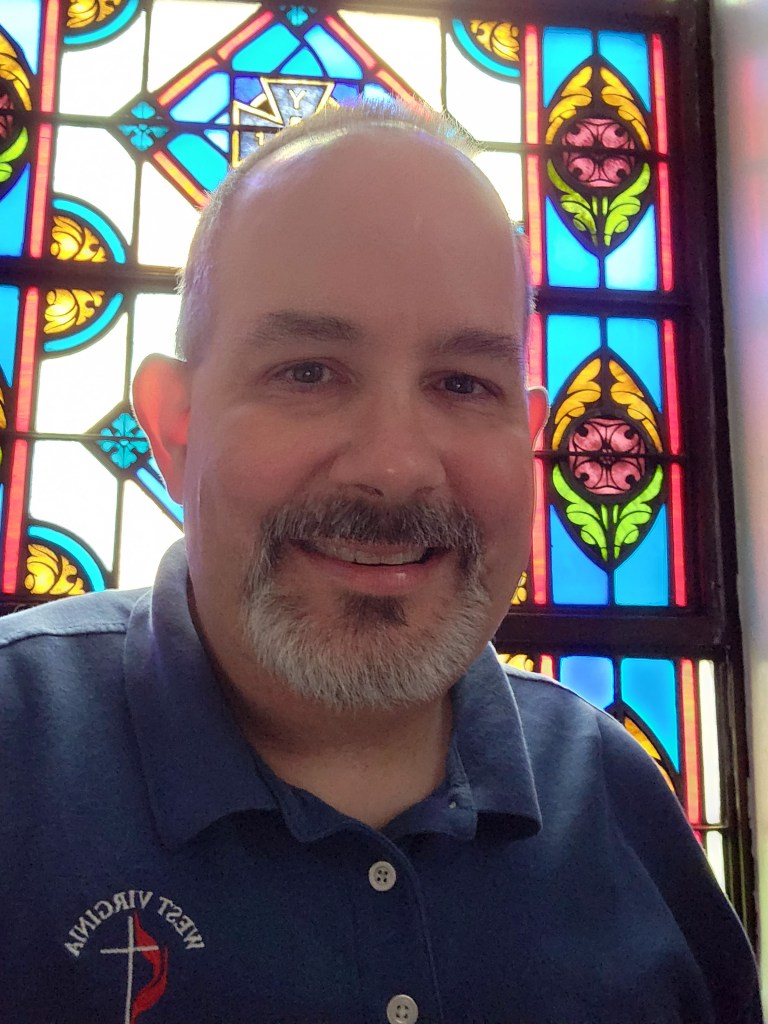
Rev. Brad Davis (he/him) is the founder of The New Society, a grassroots Central Appalachian kingdom movement. A native of one of the nation’s most economically and socially exploited regions, Brad’s passion is connecting its people to a holistic, therapeutic, liberating message of salvation he calls the Holler Gospel. Click here to read more of Brad‘s work.
Feature image courtesy West Virginia Conference of The United Methodist Church (wvumc.org)
 Accidental Tomatoes
I could relate to your heartfelt story as I read it. It also saddens me as I have heard so many similar stories. I pray for my friends who continue in patsoral ministry. I left my American Baptist seminary before finishing years ago over the “women in ministry issue” which also ended up ending my marriage to a fellow student. I also left the donomination as individual churches were becoming more socially and politically conservative. My ministry is to live as a lay person shining the light and love of God our into the world. I have the utmost respect for my brothers and sisters in pastoral minstry and wish you the best.
LikeLike
Pingback: UM Fallout: A Compendium – People Need Jesus